
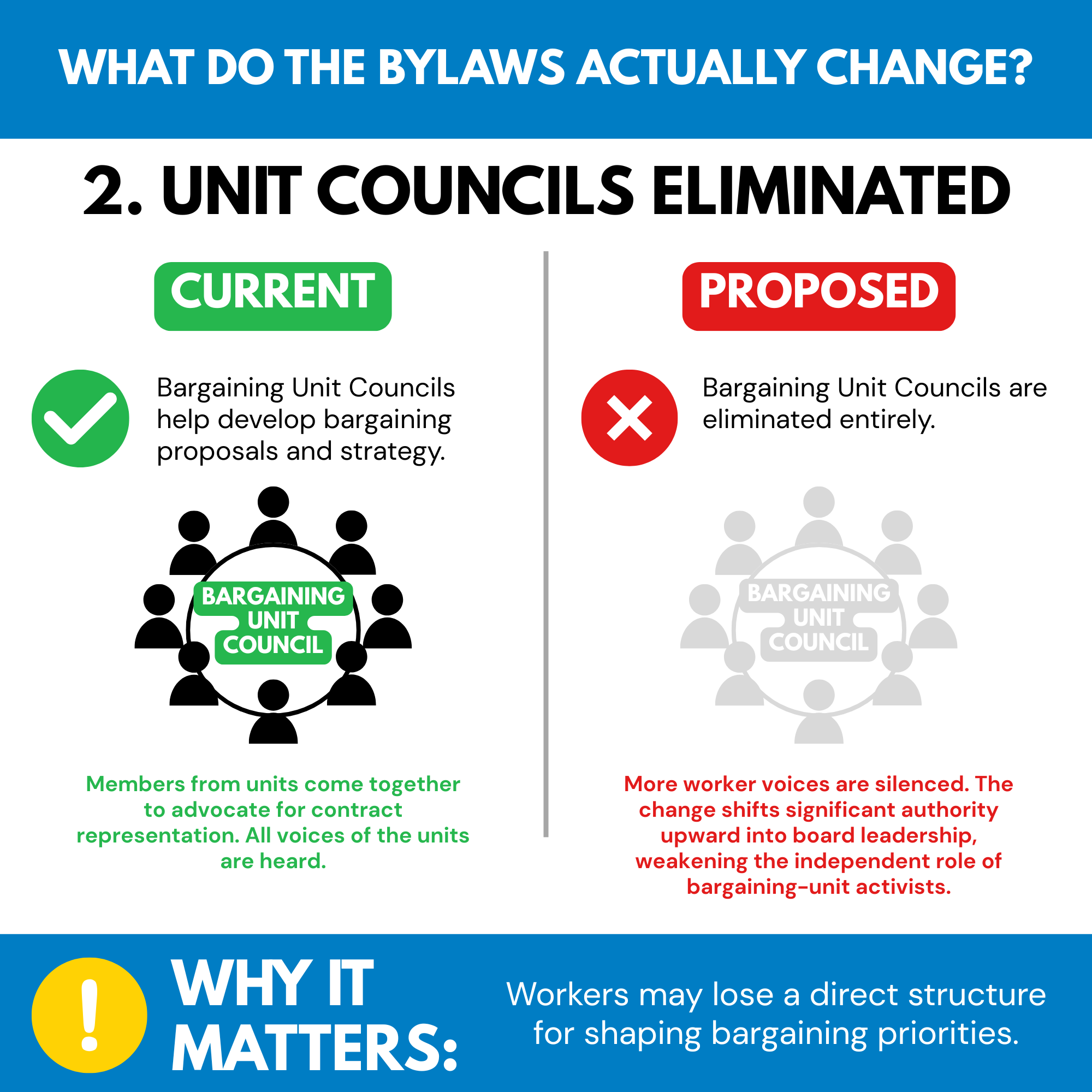
Current Structure
Bargaining Unit Councils currently serve as the primary democratic voice for members within each bargaining unit. They bring together activists, stewards, and leaders from across the state who work in the classifications covered by that bargaining unit.
Bargaining Unit Councils currently:
- Develop bargaining proposals
- Select bargaining committees
- Direct bargaining strategy
- Elect their own leadership
The policy file explicitly states that Bargaining Unit Councils are “solely responsible” for developing bargaining proposals and selecting bargaining committees. This structure ensures that the members most directly affected by a contract have a meaningful voice in shaping bargaining priorities and determining who represents them at the bargaining table.
Proposed Structure
Bargaining Unit Councils disappear.
Instead:
- Negotiation teams are elected.
- Negotiation teams operate under the direction of the Executive VP for Representation.
- Bargaining goals and policies come from the Board.
The proposal shifts bargaining authority away from independent Bargaining Unit Councils and into a more centralized governance structure.
Why this is controversial
Collective bargaining is one of the most important functions of a union. It determines wages, benefits, working conditions, job protections, and the rights members have in the workplace.
Under the current structure, members can participate directly in bargaining discussions through their Bargaining Unit Councils and their monthly statewide meetings. These councils provide a forum where members working in the same classifications can debate priorities, develop proposals, and influence bargaining strategy.
The proposal shifts significant authority upward into:
- The Executive Vice President for Representation
- The Board of Directors
- A centralized leadership structure
This weakens the independent role of bargaining-unit activists.
Every contract provision that affects your paycheck, benefits, workload, job security, and workplace rights begins with bargaining. To truly improve democratic leadership, we should expand the number of Bargaining Unit Councils to include any new Bargaining Units (Unit 15, Auxiliaries, etc.) and provide the Chair and Vice-Chair seats on the Board of Directors. That is how you ensure all members have a voice.
The question raised by this proposal is not simply how negotiations are organized. The question is who controls the bargaining process.
Under the proposed system, bargaining authority becomes more centralized and more dependent on statewide leadership.

